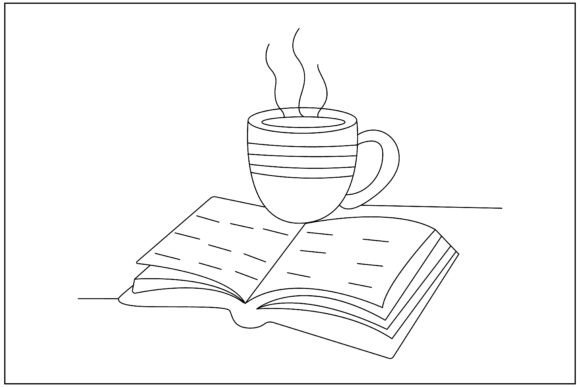
Coffee Mug Books Table Line Art
A Quiet Moment, Cleanly Stitched
First impression? This isn’t a bold statement piece—it’s a thoughtful pause. Coffee Mug Books Table Line Art lands with gentle confidence: minimal linework, balanced negative space, and an unmistakable cozy-literary vibe. It feels like the kind of design you’d sketch in the margin of a well-worn novel—unhurried, intentional, and quietly confident. As an embroidery designer who’s stitched hundreds of client projects, I immediately saw its strength: it doesn’t shout. It invites. That makes it ideal for handmade products where subtlety reads as sincerity—think embroidered kitchen towels for a boutique, linen pillow covers for a nursery, or a small chest logo on a baby onesie.
Where It Shines in Real Embroidery Projects
I recently tested Coffee Mug Books Table Line Art on a natural canvas tote bag destined for a local indie bookstore’s staff gift set. Using a medium-weight tear-away stabilizer and 40-weight rayon thread, the result was clean, legible, and deeply tactile—no bleeding, no puckering. The line weight holds up beautifully in running stitch, especially at 3–4 inches wide. It translated just as well on a relaxed-fit cotton sweatshirt (with cut-away stabilizer), where the simplicity kept the design from competing with the garment’s texture.
It’s also a smart choice for baby embroidery—soft, non-distracting, and theme-appropriate for storytime-themed onesies or burp cloths. On tea towels? Perfect. The open composition leaves room for stitching to breathe, and the lack of dense fill areas means less risk of stiffness or thread buildup after repeated washes. For Etsy sellers, this is a low-risk, high-appeal digital embroidery file: it pairs easily with neutral apparel, fits seamlessly into “cozy home” or “book lover” collections, and works across multiple product mockups without visual fatigue.
Where to Proceed With Care
That same elegance becomes a limitation in certain contexts. On curved surfaces—like the front panel of a structured cap—the thin lines can distort if hooping isn’t precise or if the fabric shifts mid-stitch. I recommend avoiding it for very small hoop sizes (< 3 inches) unless you’re willing to simplify or trace key outlines manually. Tiny lettering isn’t present here, but the delicate stem of the mug handle and the spine detail on the smallest book demand attention: test stitch those sections first on scrap fabric matching your final substrate.
Texture matters. On highly napped fabrics like fleece or terry cloth, fine lines may blur or disappear entirely. On dark fabric, contrast becomes critical—light thread (ecru, light grey, soft sage) reads cleanly, but white can look stark and clinical. And while the design is technically “line art,” don’t assume it’s automatically optimized for applique: there’s no built-in satin border or underlay, so adding that yourself requires extra digitizing judgment. Also, avoid layering it over busy prints or textured weaves—this design earns its charm through clarity, not contrast.
What It Adds to Your Finished Product—Beyond Aesthetics
Coffee Mug Books Table Line Art elevates perceived value by signaling intentionality. Customers notice when a design feels considered—not just placed, but *curated*. That translates directly to trust: a customer buying a personalized embroidered pillow cover with this motif assumes care went into both the stitching *and* the selection. For craft businesses, it reinforces brand consistency in collections centered around mindfulness, literature, or slow living. It’s gift-ready without being cutesy—ideal for teachers, librarians, writers, or anyone who treasures quiet ritual. And because it avoids trends (no slang, no seasonal icons), it stays commercially relevant year after year.
Practical Notes Every Embroidery Designer Should Check
- Always test first: Run a sample on the exact fabric + stabilizer combo you’ll use—even if it’s just one mug outline.
- Review stitch density: Though line-based, some curves may auto-generate denser runs. Zoom in on your embroidery software to confirm smooth transitions.
- Confirm hoop size compatibility: The full scene fits comfortably in a 5x7 hoop, but isolate elements (just the mug, just the stack of books) if working with smaller frames.
- Check thread color contrast: Try black thread on cream linen, then ecru on navy denim—see which tells the story you want.
- Use proper stabilizer: Light to medium cut-away for knits; tear-away for stable wovens; optional topping for fuzzy fabrics.
- Test in monochrome mockups: Convert to grayscale to spot unintended weight imbalances before stitching.
- Verify licensing: Since this falls under Illustrations and Graphics, confirm whether commercial use (e.g., selling finished embroidered totes on Etsy) is permitted—don’t assume.
Final Thought: A Design That Respects the Handmade
In a market flooded with overly complex, over-digitized embroidery files, Coffee Mug Books Table Line Art stands out by honoring restraint. It doesn’t try to do everything—it does one thing well: evoke warmth, focus, and calm. That makes it unusually versatile for custom apparel, nursery decor, holiday embroidery, and small shop merchandise. It’s not flashy, but it’s memorable. Not loud, but it lingers. And for designers, crafters, and creative entrepreneurs building something real—not just fast—Coffee Mug Books Table Line Art is the kind of digital embroidery file that earns repeat use, not one-off novelty.