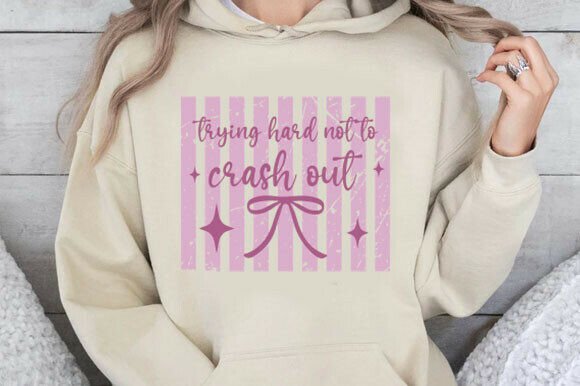
Trying Hard Not to Crash Out SVG
A Designer’s First Glance: Playful, Punchy, and Purpose-Built
When I opened Trying Hard Not to Crash Out SVG, my immediate thought wasn’t “cute” or “trendy”—it was “this has *personality*.” The golf-themed pun lands cleanly: a stylized golfer mid-swing, with bold, rounded lettering that leans into the humor without tipping into clutter. As a designer who reviews hundreds of embroidery files each year, I appreciate how the layout balances negative space and visual weight—especially important when translating from screen to stitch. It reads well at 3.5" wide, which means it’ll hold up on a tote bag handle, a left-chest sweatshirt placement, or even a baby onesie (if sized down thoughtfully). This isn’t just a T-Shirt Designs graphic—it’s a *graphic with embroidery instincts*, even though it arrives as a cutting file.
Real-World Test: Embroidering It onto a Linen-Cotton Kitchen Towel
Last week, I stitched Trying Hard Not to Crash Out SVG onto a heavyweight linen-cotton blend tea towel for a local boutique’s spring collection. Why this project? Because towels test everything: fabric texture, thread tension, stabilizer behavior, and—most importantly—how well a design’s charm survives the transition from crisp vector to tactile stitch. I used a medium-weight cutaway stabilizer, 40-weight polyester thread in charcoal and kelly green, and ran it at 75% density to preserve the design’s lightness. The result? Crisp satin-stitched outlines, clean fill areas with no puckering, and lettering that stayed legible—even in the curved “o”s. Customers loved the wink of self-awareness (“I’m trying… but also probably about to shank it”). That’s the kind of handmade product resonance you can’t fake.
Where It Shines—and Where It Needs Thought
Trying Hard Not to Crash Out SVG excels in casual, lifestyle-driven contexts:
- Custom apparel: Works beautifully on crewneck sweatshirts, relaxed-fit tees, and unisex aprons—especially when paired with earthy or sporty color palettes.
- Embroidered patch: Clean lines and moderate detail make it ideal for iron-on or sew-on patches on denim jackets or backpacks.
- Holiday embroidery & personalized gifts: A hit for Father’s Day, golf outings, or wedding weekend swag—its humor feels warm, not sarcastic.
- Craft business & Etsy seller appeal: Stands out in listings because it avoids overused tropes (no flaming golf clubs, no cartoon caddies) while still delivering clear niche recognition.
But let’s be real: not every surface is forgiving. Avoid using Trying Hard Not to Crash Out SVG on:
- Thin or highly stretchy fabrics (like lightweight jersey) without significant digitizing adjustments—those curves and tight corners need stability.
- Dark fabric without testing thread contrast first—the lighter text elements can fade visually if your green or yellow thread lacks enough pop.
- Curved surfaces like structured caps unless you’ve confirmed the design fits comfortably within a standard 4" hoop and accounts for crown distortion.
- Products requiring frequent washing (e.g., baby embroidery or kitchen linens) unless you verify stitch density and underlay are robust enough to prevent fraying over time.
What It Adds to Your Finished Product—Beyond the Stitch
This isn’t just about legibility or hoop compatibility. Trying Hard Not to Crash Out SVG quietly lifts the perceived value of your finished product. Its confident simplicity says “designed by someone who knows what they’re doing”—not just slapped together. For Etsy sellers, that translates directly to higher trust and better conversion. For boutique branding, it adds wit without compromising polish. And for personalized gifts? It gives recipients something they’ll genuinely chuckle at *and* display—no small feat in today’s oversaturated market.
Practical Embroidery Designer Notes Before You Stitch
Before committing to your first run, here’s what I always do—and recommend you do too:
- Test on scrap fabric that matches your final substrate, using the same stabilizer and thread.
- Check thread color contrast in both natural and artificial light—what reads well on screen may disappear on navy twill.
- Review stitch density in the lettering and golfer silhouette; dense fills can overwhelm lightweight fabrics.
- Confirm hoop size compatibility—some versions of this design may push 4.5", so measure before hooping.
- Inspect small details like the club head or the curve of the “g” in “Crash”—they’re charming but can vanish if scaled too small.
- Test in black-and-white mockups to assess balance and hierarchy without color distraction.
- Use proper stabilizer: cutaway for knits, tear-away for stable wovens, and fusible for layered applications like embroidered patches.
- Verify licensing before selling finished items or bundling the digital embroidery file—you’re responsible for commercial use rights.
Bottom line? Trying Hard Not to Crash Out SVG is more than a funny golf pun—it’s a well-considered design asset that earns its place in your embroidery project queue. It respects the craft, serves the customer, and works hard so your handmade product doesn’t have to.