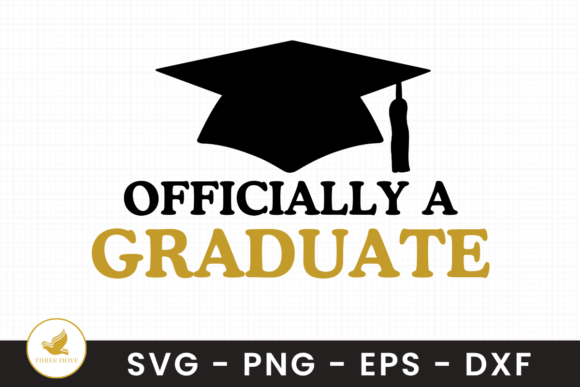
Officially Graduate SVG
A Designer’s First Look: Clean, Confident, and Ready for Real Stitching
When I opened the Officially Graduate SVG file for the first time—pulling it into my embroidery software to prep for a client’s custom embroidered tote bag—I paused. Not because it was overly complex, but because it felt *intentional*. The layout is balanced: centered text with subtle graduation cap iconography, clean lines, and generous spacing between letters. It doesn’t shout—it affirms. That tone matters more than you’d think when stitching something meant to carry pride, not just pixels. As a designer who’s stitched hundreds of graduation-themed items—from baby onesies to boutique aprons—I immediately saw where Officially Graduate SVG fits: not as a generic clipart add-on, but as a considered design asset for handmade product makers who care how their work lands.
How It Holds Up on Real Fabric (Not Just Screens)
I tested Officially Graduate SVG on three common project types: a medium-weight cotton tote, a midweight fleece sweatshirt, and a lightweight linen tea towel. On the tote? Crisp, legible, and confident—even at 3.5 inches wide. The letterforms hold their shape well in satin stitch, and the cap motif reads clearly without overloading the eye. On the sweatshirt, I used a light tear-away stabilizer and slightly reduced stitch density in the fill areas; it stayed flat and soft, no puckering. The tea towel was trickier—the fabric’s open weave made fine details less distinct, so I skipped the smallest decorative elements and focused on bold lettering only. That’s the real takeaway: Officially Graduate SVG isn’t one-size-fits-all, but it *is* adaptable—if you read its visual language and adjust accordingly.
Where It Shines (and Where to Proceed With Care)
- Best for: Sweatshirt embroidery, tote bag design, embroidered patch blanks, baby embroidery (on onesies or burp cloths), and personalized gifts like pillow covers or kitchen towels. Its moderate height and open spacing make it forgiving on textured or slightly uneven surfaces.
- Use carefully on: Stretchy fabrics like jersey knits (add cut-away stabilizer and reduce pull compensation), dark fabric (test thread color contrast—light gold or cream works better than stark white), curved surfaces like caps (hoop size must accommodate the full width comfortably), and layered garments like hoodies with thick hoods (stitch density may need trimming to avoid stiffness).
- Avoid for: Tiny hoop sizes under 4”x4”, ultra-thin silk or chiffon (no structural support for clean satin edges), or products requiring frequent high-heat washing unless you confirm thread and stabilizer durability.
What It Adds to Your Handmade Product—and What It Doesn’t
Officially Graduate SVG elevates perceived value without overcomplicating execution. Customers notice clean typography and intentional spacing—it signals professionalism, not just “I found a free download.” When stitched on a boutique-quality tote or baby blanket, it feels like part of the brand—not an afterthought. But let’s be honest: it’s not an applique design with layered textures or intricate fill patterns. It won’t replace a custom-drafted monogram or a multi-step scenic embroidery. Its strength lies in clarity and consistency—ideal for Etsy sellers batching personalized graduation gifts or small shop owners building cohesive seasonal collections. For craft fair booths or holiday embroidery bundles, it pairs beautifully with simple borders or minimal florals—never competing, always supporting.
Practical Notes Every Embroidery Designer Should Check
- Test on scrap fabric first—especially if using it for commercial embroidery or client work. Fabric texture changes everything.
- Review stitch density before sending to machine. Dense fills can overwhelm lightweight fabrics; lightening fill stitch count by 10–15% often improves drape.
- Confirm hoop size compatibility. The design’s width will determine minimum hoop requirements—don’t assume it fits a 3”x3” hoop without measuring.
- Inspect small details in your software: check corners of letters, cap brim definition, and spacing between “O” and “F” in “Officially.” Tiny gaps may vanish in stitching.
- Test black-and-white mockups to gauge contrast on light vs. dark fabric backgrounds—what looks sharp on screen may blur on navy fleece.
- Use proper stabilizer: medium-weight cut-away for knits, tear-away for stable wovens, and fusible + tear-away for linens.
- Verify licensing before selling finished products or bundling Officially Graduate SVG into digital embroidery kits—this file is labeled “DIGITAL DOWNLOAD ONLY,” so commercial use terms must be confirmed directly with the creator.
Final Thought: A Reliable Workhorse, Not a Gimmick
I’ve seen too many “graduation” designs that lean hard on clichés—over-the-top confetti, crowded fonts, or clipart-style caps that look dated before the first stitch. Officially Graduate SVG avoids all that. It’s quiet confidence in vector form. It works for a teen’s first embroidered hoodie, a proud parent’s custom apron, or a boutique’s limited-run graduation collection—all without needing redesign or heavy editing. As a T-Shirt Designs asset, it’s versatile enough for heat-transfer prep or direct embroidery. As a Graphics file, it scales cleanly for printable mockups or social media previews. If you’re curating design assets for your craft business, this isn’t flashy—but it’s dependable, respectful of your time, and kind to your machine. And in embroidery, that’s the highest compliment.