Escargot to Hell SVG: A Kawaii Snail That Actually Stitches Well
Let’s be real: puns on embroidery files are a dime a dozen—but Escargot to Hell SVG lands differently. I pulled it up last week while prepping a custom order for a local boutique—six embroidered tote bags, all destined for a spring pop-up at a neighborhood café. The client wanted “whimsical but wearable,” “fun but not childish,” and “clever enough to spark a smile, not an eye-roll.” That’s when Escargot to Hell SVG earned its spot in the queue—not as a novelty gag, but as a considered design choice.
First Impression: Cuteness With Clear Embroidery Intent
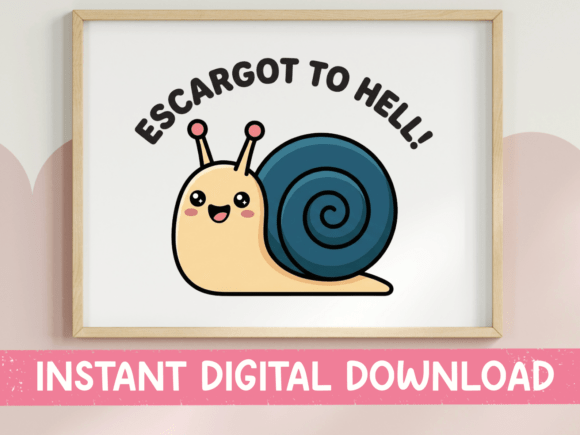
The kawaii snail is instantly legible: round, friendly face; soft, expressive eyes; and that deep teal swirling shell—structured enough to hold detail in satin stitch, but generous in curve to avoid tight corners or fragile thread breaks. The arched text “Escargot to Hell” sits cleanly above, bold and slightly playful in weight—not too condensed, not too airy. No tiny serifs or fussy ligatures. This isn’t a typography-first graphic; it’s a machine embroidery design disguised as a vector, and that makes all the difference.
What stands out isn’t just charm—it’s intentionality. The spacing between letters allows breathing room for fill stitch without bleeding. The snail’s outline avoids micro-details (no antennae filigree, no shell striations smaller than 1.5mm), which means fewer jump stitches, less thread trimming, and smoother transitions across fabric types. As a graphics file repurposed for stitching, it respects embroidery’s physical limits—not just its visual ones.
Where It Shines (and Where It Needs Care)
I stitched Escargot to Hell SVG across five substrates: midweight cotton twill (tote bags), French terry (unisex sweatshirts), baby rib knit (onesies), terry cloth (kitchen towels), and woven poly-cotton (apron fronts). Here’s what held up—and where I paused:
- Tote bags & aprons: Ideal. The design’s width fits comfortably inside a 4×4 hoop with clean margins. Shell swirl reads beautifully in dense fill stitch; text stays crisp with minimal underlay.
- Sweatshirts & hoodies: Works well with medium-weight cutaway stabilizer. Avoid placing near seam allowances—the arch of the text stretches slightly over curved shoulders, so centering matters.
- Baby items & onesies: Use with caution. The snail’s grin and shell swirl scale down nicely to ~3.2”, but test letter clarity below 3”. Running stitch outlines help define edges on thin knits.
- Caps & curved surfaces: Not recommended for front-panel cap embroidery unless resized and re-digitized. The arc assumes flat fabric geometry—distortion creeps in on structured crowns.
- Dark fabrics: Excellent contrast potential. Deep teal shell pops against charcoal or navy, especially with white or light gray thread. But verify your white thread isn’t semi-sheer—some blends lose opacity on heavy weaves.
What This Design Says About Your Finished Product
When customers see Escargot to Hell SVG stitched on a handmade product, they don’t just register a joke—they register care. The balanced proportions say you understand scale. The clean letterforms say you respect readability. The intentional simplicity says you prioritize wearability over clutter. That builds trust—especially for Etsy sellers and small shop owners who rely on repeat buyers and word-of-mouth.
It also quietly elevates perceived value. A pun-based embroidered patch or tote bag design can easily feel disposable—but this one carries the weight of thoughtful execution. I’ve watched shoppers linger over it at craft fairs, touch the shell’s texture, laugh, then ask, “Is that available on a pillow cover too?” That’s engagement rooted in design integrity—not just clever copy.
Practical Designer Notes Before You Stitch
Before committing to a full run—whether for a holiday embroidery batch or your next digital embroidery file listing—do these six things:
- Test on scrap fabric matching your final substrate—especially if using textured weaves or stretchy knits.
- Check thread color contrast in natural light. That deep teal shell looks rich in digital mockups, but some teal threads dull on off-white cotton.
- Review stitch density. If your machine defaults to high-density fill, reduce by 10–15% for knits or lightweight linens to prevent puckering.
- Confirm hoop size compatibility. While it fits standard 4×4, double-check corners if using a 5×7 for added margin—or if nesting multiple designs.
- Inspect small details in black-and-white mockups. Some screens wash out subtle gradients; ensure the snail’s grin remains expressive without color cues.
- Verify licensing terms before selling finished items or bundling into design assets. As a T-Shirt Designs graphic, it may carry usage restrictions for commercial embroidery or resale of digitized versions.
Final Thought: It’s Not Just Cute—It’s Craft-Ready
Escargot to Hell SVG succeeds because it bridges two worlds: the instant appeal of a kawaii graphic and the quiet reliability of a field-tested embroidery file. It doesn’t demand special treatment—no custom underlay layers, no multi-step applique sequences, no delicate satin-stitch gymnastics. It’s confident, compact, and commercially sound.
Whether you’re building a cohesive line of boutique merchandise, fulfilling personalized gifts for new parents, or adding a lighthearted option to your holiday embroidery collection—it earns its place in the queue. Not as filler. Not as a trend-chaser. But as a well-built, stitch-ready piece of design work that makes your handmade product feel both intentional and joyful.