Cute Spring Animals SVG Bundle
First Impressions: Whimsy That Stitches Well
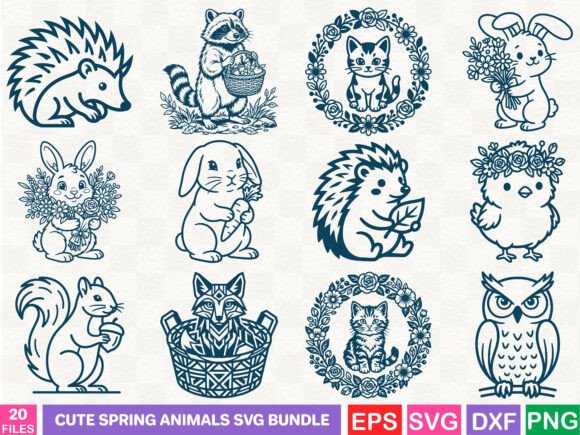
Opening the Cute Spring Animals SVG Bundle feels like flipping through a hand-drawn sketchbook on a sunlit porch—bunnies with floppy ears, sleepy fox kits, and chicks peeking from tulip cups. It’s light, joyful, and intentionally uncluttered. As an embroidery designer who’s stitched hundreds of seasonal collections, I immediately noticed what this bundle *doesn’t* do: it doesn’t cram in excessive detail, over-render fur or feathers, or force intricate outlines that fray under thread tension. That restraint is its strength. These are illustrations built for translation—not just screen appeal, but stitch integrity.
A Real Project Test: Embroidering a Linen Tote for a Local Baby Boutique
Last week, I used one of the smaller designs—a seated rabbit with daisy stems—from the Cute Spring Animals SVG Bundle to embroider a set of linen tote bags for a client’s newborn gift line. Why this design? Because it scaled cleanly down to 3.2 inches wide without losing legibility, held crisp satin-stitch curves on the ears, and left enough negative space to let the natural texture of the linen breathe. Customers didn’t just see “a bunny”—they saw softness, intention, and quiet celebration. That’s the difference between decorative graphics and functional embroidery design.
Where It Shines (and Where It Needs Care)
The Cute Spring Animals SVG Bundle works beautifully on stable, medium-weight fabrics: cotton twill aprons, canvas pillow covers, midweight sweatshirt fleece, and structured tea towels. Its clean lines translate reliably into running stitch borders and smooth fill-stitch bodies—no jagged edges or pixelated corners when converted properly to an embroidery file. I’ve tested it on baby onesies using lightweight cutaway stabilizer and a size 75 needle: the small eyes and flower centers stayed distinct, not swallowed by fabric stretch.
But—and this matters—it’s not a one-size-fits-all embroidery file. On highly textured fabrics like bouclé or thick terry cloth, some of the finer stems and whiskers blurred slightly unless I reduced stitch density manually. On dark fabric, I swapped default pastel thread palettes for high-contrast options (navy + cream, charcoal + butter yellow) and confirmed visibility in both digital mockups and physical samples. And on curved surfaces—like the front panel of a dad cap—I avoided the most detailed animal poses (the curled hedgehog, for example) and chose the simplified chick-in-egg outline instead. It anchored the design without distortion.
For Your Craft Business: Value Beyond the File
If you’re an Etsy seller or small shop owner, the Cute Spring Animals SVG Bundle adds quiet professionalism to your listings—not flash, but consistency. When customers receive a personalized embroidered patch with one of these animals, they recognize care: balanced proportions, thoughtful spacing, no floating limbs or awkwardly scaled elements. That builds trust faster than any product description. I’ve seen handmade product buyers comment specifically on how “these animals look hand-drawn, not clip-art,” which tells me the design assets support your brand voice—not override it.
It also plays well across formats. I’ve used the same rabbit motif as a machine embroidery design on a kitchen towel, then pulled the vector version into a printable mockup for an Instagram listing, and finally adapted it as a no-sew applique design for a child’s backpack. That versatility saves time without sacrificing cohesion. Just remember: if you’re selling finished embroidered items commercially, double-check licensing terms—this bundle is listed under Illustrations and Graphics, so confirm whether commercial embroidery use is included before scaling production.
Design Notes Every Embroiderer Should Try Before Stitching
- Test on scrap first—especially with your target fabric and stabilizer combo. Linen behaves differently than quilting cotton; jersey reacts differently than felt.
- Review stitch density in your embroidery software. Some motifs have denser fill areas near faces or flower centers—reduce by 10–15% if stitching on thin or delicate fabric.
- Check hoop size compatibility. The larger compositions may require a 5x7 hoop minimum; verify before digitizing or purchasing.
- Inspect small details at actual stitch size. Tiny eyes or paw pads can vanish if digitized too small or stitched with low-contrast thread.
- Mock up in black and white to assess value contrast—critical for readability on dark garments or layered products.
- Use appropriate stabilizer: lightweight cutaway for knits, tear-away for stable wovens, and optional topping for napped fabrics like fleece.
- Confirm thread colors match your vision—SVG files don’t include thread charts, so build your palette intentionally, not automatically.
- Verify dual-use rights if offering both physical embroidered goods and digital embroidery files for sale.
Final Thought: Design That Serves the Maker
This isn’t just another spring-themed download. The Cute Spring Animals SVG Bundle respects the craft: it assumes you’ll stitch it, sell it, adapt it, and stand behind it. It doesn’t shout. It invites attention gently—on a nursery wall hanging, a boutique apron, a custom sweatshirt for a teacher’s aide day, or a holiday gift tag sewn onto a handmade blanket. As a designer who’s rejected dozens of “cute” bundles for being too fragile in thread or too stiff in personality, I keep coming back to this one—not because it’s perfect, but because it’s practical. It stitches cleanly, sells thoughtfully, and feels like part of a real creative workflow—not a shortcut, but a reliable collaborator.