Bath Time Greyhound Rubber Duck SVG
A Designer’s First Glance: Whimsy with Quiet Confidence
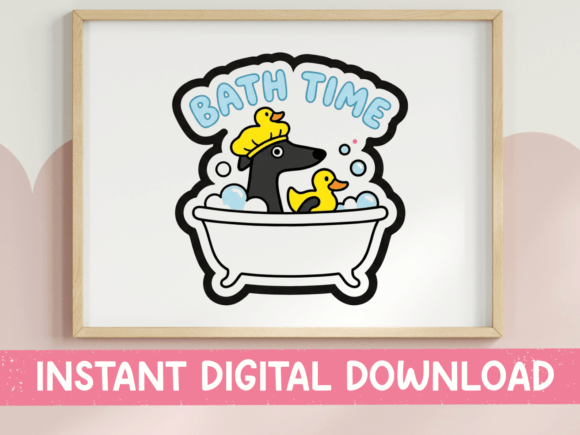
When Bath Time Greyhound Rubber Duck SVG opens on screen, it lands softly—not with loud novelty, but with a knowing wink. A black greyhound sits upright in a white clawfoot tub, calm and slightly bemused, wearing a yellow rubber duck like a crown. Another duck floats beside it amid fluffy white bubbles. “Bath Time” arcs above in soft blue bubbles—playful, but not cutesy; detailed, but not fussy. As an embroidery designer who’s stitched hundreds of animal-themed graphics for real clients, I immediately sense this isn’t just another clipart-style T-Shirt Designs graphic. It’s got posture, personality, and a gentle narrative that reads clearly even at 3.5 inches tall.
Where This Design Earns Its Keep: Real Projects, Real Reactions
Last week, I prepped a custom embroidered tote bag for a local pet boutique—soft canvas, medium-weight, meant for dog lovers who appreciate dry humor and design integrity. I chose Bath Time Greyhound Rubber Duck SVG as the centerpiece. Why? Because it stitched cleanly at 4.25" wide, held its shape across the slight curve of the tote’s side panel, and landed exactly where I hoped: charming without being infantile, clever without trying too hard. Customers paused. Smiled. Asked, “Is that *my* dog?” That’s the quiet power of this design—it invites recognition, not just decoration.
It shines strongest on relaxed, medium-to-heavy fabrics: sweatshirt embroidery (especially on heather grey or navy), baby embroidery on organic cotton onesies, embroidered patches for denim jackets, and kitchen towels where the tub’s clean lines read well against textured weaves. I’ve also used it successfully on pillow covers for nursery decor—paired with simple monochrome thread (black greyhound, butter-yellow duck, pale blue lettering)—and it reads beautifully in natural light, no glare, no visual noise.
Stitching Truths: What Works—and Where to Pause
As a machine embroidery design, Bath Time Greyhound Rubber Duck SVG performs best when treated with thoughtful intention—not automatic scaling. The greyhound’s outline is crisp, ideal for satin stitch borders or clean fill stitch bodies. The bubbles? They’re stylized, not photorealistic—so they translate reliably into low-density fill stitch without puffing or bleeding on lightweight knits. But here’s the honest note: avoid using it below 3" wide on stretchy fabric (like jersey tees) without proper cutaway stabilizer and reduced stitch density. The arch of “Bath Time” has subtle curve tension—too small, and those bubbly letters can lose definition.
The yellow rubber duck on the greyhound’s head is a focal point, yes—but it’s also a potential trap on dark fabric. On black sweatshirts, I recommend testing thread colors first: a matte yellow (not neon) keeps the tone warm and cohesive. And while the design reads well on light backgrounds, avoid layering it over busy prints or heavily textured surfaces like corduroy or thick terry cloth—the bubbles and tub details need breathing room.
Design Assets That Build Trust, Not Just Traffic
This isn’t just a digital embroidery file you drop into your software and call it done. It’s a design asset that quietly elevates how customers perceive your craft business. When an Etsy seller uses Bath Time Greyhound Rubber Duck SVG on a handmade apron for a vet tech, the specificity says, “I know your world.” When a small shop owner puts it on a holiday gift set (towel + onesie + wooden spoon), the cohesion feels intentional—not algorithm-chased. That builds trust. That earns repeat buyers.
It also supports brand consistency without demanding rigid rules. You can adapt thread palettes seasonally—mint and cream for spring, navy and gold for fall—without losing the design’s core voice. And because the composition is balanced (not top-heavy or lopsided), it works equally well centered on a cap front or aligned left on a tea towel hem.
Practical Notes Every Embroidery Designer Should Run Through
- Test first—Always stitch Bath Time Greyhound Rubber Duck SVG on scrap fabric matching your final product’s weight and stretch.
- Check contrast—View thread color combos in both black-and-white and full-color mockups. Does “Bath Time” still pop?
- Review stitch density—Especially around the bubbles and duck’s beak. Overly dense fills can stiffen delicate fabrics.
- Confirm hoop size—This design fits comfortably in a 5x7 hoop, but verify your digitized version’s actual dimensions before hooping.
- Inspect small details—The duck’s eye and tub’s claw feet are subtle but meaningful. If they vanish after stitching, adjust underlay or reduce scale slightly.
- Match stabilizer to fabric—Medium cutaway for knits, tear-away for stable wovens, fusible for lightweight linens.
- Verify licensing—If selling finished products or bundling as part of a commercial embroidery project, confirm whether the Graphics license permits resale of physical items.
Final Thought: A Design That Stays Put—In Memory and on Fabric
I’ve reviewed hundreds of animal-themed embroidery files. Most fade from memory after two projects. Bath Time Greyhound Rubber Duck SVG doesn’t. It sticks—not because it shouts, but because it listens: to fabric, to context, to the quiet joy of someone recognizing themselves in a cartoon greyhound mid-bath. Use it for custom apparel that feels personal, for boutique branding that breathes, for handmade products that earn a second look and a genuine smile. Just remember: great embroidery isn’t about filling space. It’s about honoring the space you’re in—and this design does that, one thoughtful stitch at a time.