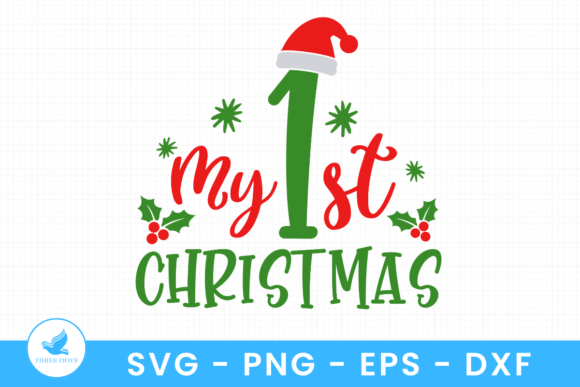
Baby’s First Holiday SVG – Christmas
First Impressions: Sweet, Simple, and Seasonally Sincere
When I opened the Baby’s First Holiday SVG – Christmas file, what struck me wasn’t flash—it was warmth. The composition is centered, gently rounded, and intentionally uncluttered: a soft wreath framing “Baby’s First Holiday” above a small star or snowflake motif (depending on version), all in clean, friendly lettering. It reads like a handwritten keepsake—not a stock graphic, but something you’d tuck into a baby’s memory box. That sincerity matters. For embroidery designers and small shop owners, this isn’t just decoration; it’s emotional shorthand. It tells customers, *“This is meaningful. This is made for a moment.”*
A Real Project Test: Embroidering a Holiday Tote for a New Parent
Last week, I prepped a custom canvas tote for a client expecting her first child—a holiday gift for grandparents. I chose the Baby’s First Holiday SVG – Christmas as the centerpiece, stitching it front-and-center on a natural cotton canvas. Why? Because its balanced proportions scaled beautifully at 4.5 inches wide—large enough to read clearly, small enough to avoid overwhelming the fabric. The design’s open letterforms and moderate spacing translated cleanly into satin stitch outlines and light fill-stitch interiors. No thread nesting. No skipped stitches—even on the subtle curve of the wreath. That’s not luck. It’s thoughtful vector construction.
Where It Shines (and Where It Needs Care)
This design excels in applications where clarity, charm, and gentle scale matter most:
- Soft baby items: Onesies, burp cloths, and receiving blankets benefit from its low-detail elegance—no tiny branches or micro-ornaments that vanish under dense stitching.
- Tote bags & tea towels: The centered layout anchors the piece without competing with texture or pattern. Works equally well on linen, canvas, or midweight cotton.
- Sweatshirts & crewneck tees: When digitized properly, the lettering holds legibility even over fleece backing—especially with a light tear-away stabilizer.
- Embroidered patches: Its contained shape and minimal internal detail make it ideal for iron-on or sew-on patches meant for nursery decor or baby shower favors.
But—and this is critical—Baby’s First Holiday SVG – Christmas isn’t built for every surface. Avoid it on:
- Curved, tight areas like cap fronts (the wreath shape distorts easily without careful hooping and underlay adjustment);
- Ultra-thin fabrics like voile or lightweight rayon (lettering can shadow through or pucker without medium-weight cut-away stabilizer);
- Dark, textured knits where fine details blur unless you increase contrast with brighter thread or add subtle underlay;
- Projects requiring frequent washing (e.g., bibs) unless you confirm stitch density allows for durability—test wash one sample first.
What It Adds to Your Handmade Product—Beyond Aesthetics
For Etsy sellers and boutique makers, this design quietly lifts perceived value. It doesn’t scream “holiday sale”—it whispers “thoughtful heirloom.” That distinction builds trust. Customers browsing handmade baby embroidery recognize intentionality: the spacing feels considered, the curves are smooth (not jagged), and the overall weight suggests care—not algorithmic filler. When paired with quality thread and stable fabric, the finished product reads professional, not DIY-casual. And because it avoids trendy clichés (no cartoon reindeer, no glitter fonts), it stays relevant beyond a single season—ideal for evergreen listings or year-round nursery collections.
Practical Designer Notes Before You Stitch
Before committing to a client order or bulk run, here’s what I always do with a new digital embroidery file like Baby’s First Holiday SVG – Christmas:
- Test on scrap fabric—same type and weight as your final product, with the exact stabilizer you plan to use.
- Check thread color contrast on both light and dark backgrounds. Light gray or heather charcoal thread often reads warmer and more cohesive than stark white on natural canvas.
- Review stitch density visually in your embroidery software. Look for overlapping fills or overly tight satin columns—especially in the wreath base and letter counters.
- Confirm hoop size compatibility. While the SVG itself is scalable, embroidery digitizing affects how well it handles resizing. If you’re planning a 2-inch version for a onesie, verify small-letter legibility in stitch simulation.
- Inspect corners and curves in the PNG preview—smooth vectors usually digitize cleaner than those with excessive anchor points or compound paths.
- Use black-and-white mockups to assess visual weight and balance before stitching. Does it hold presence without shouting?
- Verify licensing—this is a digital download for personal *and* commercial use, but always double-check terms before listing finished embroidered goods or reselling the file itself.
Final Thought: A Quiet Workhorse for Meaningful Moments
Baby’s First Holiday SVG – Christmas won’t dominate a craft fair table with spectacle—but it will earn repeat orders from parents who want something tender, timeless, and true. It fits naturally within T-Shirt Designs and Graphics categories, yes, but its real strength lies in elevating everyday handmade products: a stitched pillow cover for a newborn’s nursery, a personalized sweatshirt for a first Christmas photo, or a delicate patch sewn onto a handmade baby blanket. As a designer and reviewer, I keep this file in my “trusted seasonal rotation”—not because it’s flashy, but because it delivers quiet reliability, emotional resonance, and real-world stitchability. That’s the kind of design that builds a craft business, one thoughtful, well-embroidered item at a time.