ADHD SVG Bundle: A Designer’s Real-World Embroidery Review
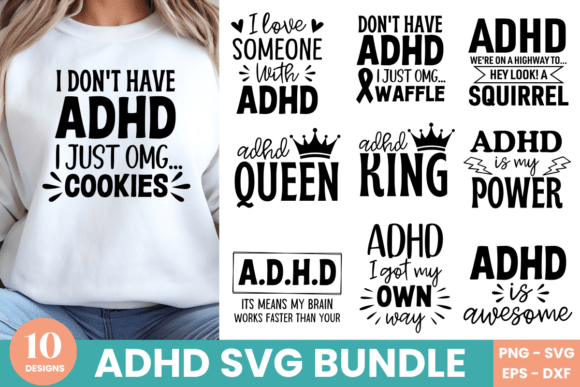
Let’s be honest—I opened the ADHD SVG Bundle expecting bold, playful energy. What I found was something more nuanced: a set of 10 clean, thoughtful graphics that balance advocacy with approachability. As someone who regularly translates digital designs into stitched reality—whether for custom embroidered tote bags, baby onesies, or boutique sweatshirts—I looked past the “SVG” label and asked: *Will this hold up under needle and thread? Will it resonate with real people wearing real clothes?*
I tested it on a medium-weight cotton twill tote bag meant for a local neurodiversity awareness pop-up. Not as a print—but as an embroidered patch, fused then stitched with satin and fill stitch. The result? Surprisingly strong visual impact without visual noise. The shapes are generous but not oversized; the lines have breathing room, and none of the 10 designs rely on micro-detail that would vanish in thread.
What This Bundle Feels Like—Before You Stitch a Single Thread
The ADHD SVG Bundle leans into warmth—not clinical precision. There’s heart-shaped neurons, subtle brain silhouettes wrapped in soft loops, friendly “Focus Fuel” lettering, and one especially effective design with overlapping gears and a ribbon. None feel infantilizing or overly medicalized. That matters—especially when you’re stitching for teens, adults, educators, or parents choosing gifts for a child’s first therapy session or school presentation.
These aren’t just T-Shirt Designs—they’re graphics with emotional weight. And that changes how they behave in embroidery. On a kitchen towel? Calm and grounded. On a baby onesie? Gentle and affirming. On a structured cap? You’ll want to avoid the most intricate layouts—the curved surface compresses fine spacing, and small interior cutouts (like gear teeth) may not register clearly in dense fill stitch.
Where It Shines—and Where You’ll Want to Pause
This bundle works beautifully for:
- Custom apparel—especially crewnecks and relaxed-fit tees where stitch clarity isn’t compromised by stretch or tight seams
- Embroidered patches—the SVG outlines translate cleanly into applique-ready edges, and the moderate detail level holds up after heat-sealing and top-stitching
- Baby embroidery—soft curves, no sharp angles, and balanced negative space make these ideal for onesies and burp cloths (just confirm stabilizer choice for lightweight knit)
- Holiday embroidery—I used one of the “Neurospicy & Proud” variants on linen pillow covers for a client’s ADHD-friendly holiday gift set. It read instantly, even at 3.5” wide.
- Small shop product—these designs lend themselves well to cohesive branding across mugs, tote bags, and tea towels when used consistently with matching thread palettes.
But here’s where attention matters:
- Thin or highly textured fabric: Avoid dense fill areas on loosely woven linens or nubby terry cloth—the stitch density can pull or sink unevenly.
- Dark fabric: The PNGs are high-res and transparent, yes—but test contrast. Some lighter-line motifs need careful thread color pairing (e.g., light gray thread on navy won’t read like charcoal on cream).
- Curved surfaces: That lovely brain-and-butterfly design? Gorgeous flat. On a structured cap front? Scale down by 10–15% and simplify interior elements before digitizing.
- Frequent-wash items: These aren’t minimalist line art. Several include layered shapes—so verify your digitizer uses proper underlay and reduces stitch jumps in tight corners to prevent fraying over time.
How It Shapes Your Finished Product—and Your Customer’s Experience
A well-executed ADHD SVG Bundle embroidery doesn’t just look good—it builds trust. When someone sees a carefully stitched “My Brain Works Differently” motif on a handmade apron, they don’t just see a design. They see intention, respect, and craft. That elevates your entire offering: whether you’re an Etsy seller listing personalized gifts, a small shop owner curating inclusive merchandise, or a creative entrepreneur building a neuro-affirming brand.
Visually, these graphics hold their own next to hand-lettered or illustrative embroidery files—but they’re easier to scale, digitize, and adapt. No tiny serifs. No overlapping transparency traps. Just clear, confident shapes with built-in rhythm. That means faster mockup prep, smoother client approvals, and fewer “can you fix the stitching on the ‘D’?” revisions.
Practical Notes Every Embroidery Designer Should Keep Handy
Before committing to a full run—or listing your first ADHD SVG Bundle-inspired product—do these five things:
- Test on scrap fabric first—especially if using stretchy knits or lightweight cotton. Note how stabilizer choice affects edge definition in satin-stitched outlines.
- Check thread color contrast across at least three fabric tones: light, mid, and dark. A design that pops on white may disappear on heather gray.
- Review stitch density in your embroidery software. If your digitizer hasn’t optimized for low-density fills, manually reduce density in large solid areas to prevent stiffness.
- Confirm hoop size compatibility—some designs hit 4.5” wide. If you’re working with smaller hoops (like 3” x 3”), plan for repositioning or simplified versions.
- Inspect small details at actual stitch size. Zoom in on your screen, then step back—does the “focus” icon still read as a lens, or just a blob?
And one final note: since this is a DIGITAL DOWNLOAD ONLY bundle with SVG and PNG files, remember—you’ll need to digitize it yourself or work with a digitizer to create a true machine embroidery design. SVGs aren’t embroidery files out of the box. They’re design assets—flexible, scalable, and full of potential—but they require that extra layer of translation to become a crisp, balanced, wash-tested finished product.
If you’re an embroidery designer, craft business owner, or Etsy seller looking for Graphics that carry meaning *and* stitch well—this bundle earns its place in your working library. Not because it’s flashy, but because it’s considerate: in shape, in scale, and in spirit.